
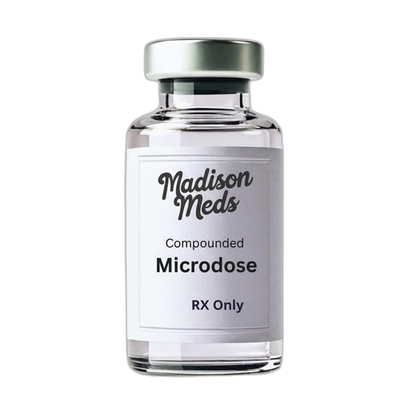
Microdose GLP-1
Semaglutide and Tirzepatide, Weekly Injectable
Pillar reference on microdose GLP-1 therapy. Microdosing refers to weekly doses below the FDA-approved starting dose (0.25 mg for semaglutide, 2.5 mg for tirzepatide). This is an off-label practice not approved by the FDA. Available after a licensed-provider evaluation by an independent network of US-licensed providers, with medication dispensed by a US-licensed compounding pharmacy. Educational content, not medical advice.
Starting from $99 your first month
Sema microdose from $99 first month, then $149/mo | Tirz microdose from $149 first month, then $199/mo | Cancel Anytime
Frequency
Weekly
Rx Required
Yes, Prescribed Online
Pharmacy
US-Registered
Shipping
Free & Discreet
How Microdose GLP-1 Works
Semaglutide is a glucagon-like peptide-1 (GLP-1) receptor agonist. It is administered as a once-weekly subcutaneous injection. Semaglutide activates GLP-1 receptors in the pancreas, brain, and gastrointestinal tract, contributing to reduced appetite, slower gastric emptying, and improved glycemic control. Standard FDA-approved weekly doses run from 0.25 mg (titration start) to 2.4 mg (maintenance, Wegovy) or 2.0 mg (Ozempic).
Tirzepatide is a dual GIP and GLP-1 receptor agonist. It is also a once-weekly subcutaneous injection. Tirzepatide activates both the glucose-dependent insulinotropic polypeptide (GIP) receptor and the GLP-1 receptor. Standard FDA-approved weekly doses run from 2.5 mg (titration start) to 15 mg (maintenance, Zepbound and Mounjaro).
Microdose refers to using weekly doses below those FDA-approved starting doses. This is an off-label practice not approved by the FDA. No dose below the FDA-approved starting dose has been tested in a randomized controlled trial for safety or efficacy. Reports on subtherapeutic dosing are limited to observational case series and pharmacokinetic modeling. The rationale patients sometimes cite is dose-response reasoning from STEP-1 and SURMOUNT-1, which showed measurable appetite and weight effects at titration doses (0.25 mg semaglutide, 2.5 mg tirzepatide) versus placebo. Whether that dose-response continues below those starting points has not been established. Available after a licensed-provider evaluation. Educational content, not medical advice. Individual results vary.
What to Know About Microdose Protocols
Off-Label Practice
Weekly doses below the FDA-approved starting dose (0.25 mg for semaglutide, 2.5 mg for tirzepatide) have not been tested in a randomized controlled trial and are not endorsed by the manufacturer. Any use should occur under provider supervision.
GI Tolerability Is Dose-Related
In FDA-approved trials, gastrointestinal side effects were reported more frequently at higher doses. Observational reports on subtherapeutic doses describe lower reported rates. Individual tolerability varies. Discontinuation for tolerability can occur at any dose.
Dose-Response in Approved Ranges
STEP-1 (Wilding, NEJM 2021) and SURMOUNT-1 (Jastreboff, NEJM 2022) both documented a clear dose-response for weight change across approved dose ranges. Whether that response continues below the FDA-approved starting doses has not been established.
Maintenance Evidence Gap
STEP-4 (Rubino, JAMA 2021) documented weight regain after discontinuation of semaglutide. SURMOUNT-4 (Aronne, JAMA 2024) documented the same for tirzepatide. Subtherapeutic dosing as a maintenance strategy has not been tested in a randomized controlled trial.
Provider Oversight Required
Contraindications and boxed warnings apply at any dose: personal or family history of medullary thyroid carcinoma, Multiple Endocrine Neoplasia syndrome type 2, pregnancy, breastfeeding, pancreatitis history, or severe gastroparesis. Eligibility is determined by an independent network of US-licensed providers.
Compounded, Not Brand
Madison Meds dispenses compounded semaglutide and tirzepatide through a US-licensed compounding pharmacy. Compounded medications are not FDA-approved as finished drug products. They are not Wegovy, Ozempic, Zepbound, or Mounjaro. Off-label.
How Microdose Access Works Through Madison Meds
Online Licensed-Provider Evaluation
A prospective patient completes an online intake covering medical history, current medications, allergies, and goals. Information is routed to an independent network of US-licensed providers. Eligibility is determined case-by-case and is not guaranteed. Contraindications and boxed warnings apply at any dose.
Provider-Guided Protocol
When appropriate, the licensed provider issues a prescription. The medication is prepared by a US-licensed compounding pharmacy and shipped in temperature-controlled packaging. Titration, dosing frequency, and any adjustments are directed by the provider, not by Madison Meds. Compounded medications are not FDA-approved as finished drug products.
Ongoing Check-Ins
Patients maintain regular contact with the independent provider network for follow-up, tolerability review, and any protocol changes. Adverse events are reported directly to the provider. Cancellation is available at any time. Educational content, not medical advice. Individual results vary.
What Is Microdose GLP-1?
Microdose GLP-1 refers to using weekly subcutaneous injections of semaglutide or tirzepatide at doses below the FDA-approved starting doses. The FDA-approved starting dose for semaglutide is 0.25 mg once weekly (Wegovy for chronic weight management; Ozempic for type 2 diabetes). The FDA-approved starting dose for tirzepatide is 2.5 mg once weekly (Zepbound for chronic weight management; Mounjaro for type 2 diabetes).
Any weekly dose below those starting doses is off-label and has not been tested in a randomized controlled trial for safety or efficacy. Available clinical evidence at subtherapeutic doses is limited to observational reports, provider case series, and pharmacokinetic modeling. This page is a pillar reference that describes the practice honestly, cites the underlying trials, and links to the two product programs.
Through Madison Meds, compounded semaglutide microdose (from $99 first month, then $149/mo) and compounded tirzepatide microdose (from $149 first month, then $199/mo) are available after a licensed-provider evaluation by an independent network of US-licensed providers, with medication dispensed by a US-licensed compounding pharmacy. Individual results vary.
Off-Label Notice
Microdosing GLP-1 medications is an off-label practice not approved by the FDA. No dose below the lowest FDA-approved starting dose (0.25 mg for semaglutide, 2.5 mg for tirzepatide) has been tested in a randomized controlled trial for safety or efficacy. Available clinical evidence for subtherapeutic dosing is limited to observational reports, case series, and pharmacokinetic modeling. Any use should occur only after a licensed-provider evaluation, with the medication dispensed by a US-licensed compounding pharmacy. Educational content. Not medical advice. Individual results vary.
Who Explores Microdose GLP-1?
Observational reports and clinical case series describe three patterns most commonly among patients who explore microdose GLP-1 protocols with a licensed provider:
- Post-standard-dose maintenance. Patients who reached a target weight on standard-dose semaglutide (Wegovy, Ozempic) or tirzepatide (Zepbound, Mounjaro) and want a lower-dose maintenance option. STEP-4 (Rubino, JAMA 2021) documented that stopping semaglutide led to weight regain; SURMOUNT-4 (Aronne, JAMA 2024) documented the same for tirzepatide. Subtherapeutic dosing as a maintenance strategy has not been tested in a randomized trial.
- Standard-dose tolerability challenges. Patients who initiated standard-dose GLP-1 therapy and could not tolerate the titration schedule due to GI adverse events. Some providers describe lower doses as an alternative starting point. This is off-label and has not been validated in a randomized trial.
- Metabolic exploration at lower dose. Patients seeking metabolic or appetite effects at doses lower than the approved range. Reported outcomes in observational settings are variable and may reflect selection or placebo effects.
None of these use cases has been validated in a randomized controlled trial at subtherapeutic doses. Eligibility is determined by an independent network of US-licensed providers. Educational content, not medical advice.
What the Research Says
- STEP-1 (Wilding, NEJM 2021). Randomized controlled trial of weekly semaglutide 2.4 mg vs placebo in 1,961 adults with overweight or obesity. Mean body-weight reduction at 68 weeks was approximately 14.9 percent on semaglutide vs 2.4 percent on placebo. A clear dose-response was documented across the titration schedule (0.25, 0.5, 1.0, 1.7, 2.4 mg weekly). Full text.
- STEP-4 (Rubino, JAMA 2021). After 20 weeks of open-label semaglutide titration, participants were randomized to continue 2.4 mg weekly or switch to placebo. Continuing produced a further mean reduction of 7.9 percent; switching to placebo produced regain of 6.9 percent. Cessation of GLP-1 therapy was associated with weight regain. Full text.
- SELECT (Lincoff, NEJM 2023). Semaglutide 2.4 mg weekly reduced major adverse cardiovascular events by 20 percent in adults with preexisting cardiovascular disease and overweight or obesity, without diabetes. Cardiovascular endpoint reduction has been documented only at the FDA-approved dose. Full text.
- SURMOUNT-1 (Jastreboff, NEJM 2022). Randomized controlled trial of weekly tirzepatide 5, 10, and 15 mg vs placebo in 2,539 adults with obesity. Mean body-weight reduction at 72 weeks was 15.0, 19.5, and 20.9 percent for the three tirzepatide doses vs 3.1 percent on placebo. Clear dose-response across the approved range. Full text.
- SURMOUNT-4 (Aronne, JAMA 2024). After 36 weeks of open-label tirzepatide titration, participants were randomized to continue their maximum tolerated dose (10 or 15 mg weekly) or switch to placebo. Continuing produced further reduction; switching produced regain. Confirms the maintenance-dependence pattern also seen with semaglutide. Full text.
- Subtherapeutic dosing evidence base. No randomized controlled trial has tested weekly doses below 0.25 mg semaglutide or below 2.5 mg tirzepatide. Reported outcomes at those doses come from case series, provider observation, and pharmacokinetic modeling only. Institutional reviewers including Cedars-Sinai, Hackensack Meridian Health, and STAT News have emphasized this evidence gap.
Safety, Risks, and Provider Oversight
Contraindications that apply at any dose:
- Personal or family history of medullary thyroid carcinoma
- Multiple Endocrine Neoplasia syndrome type 2
- Prior serious hypersensitivity to semaglutide or tirzepatide
- Pregnancy or breastfeeding
- Active or severe pancreatitis history
- Severe gastroparesis
Adverse events that can occur at any dose: nausea, vomiting, diarrhea, constipation, abdominal pain, gallbladder disease, acute kidney injury from dehydration, injection-site reactions, and rare cases of pancreatitis. Compounded semaglutide and tirzepatide add additional considerations because they are not FDA-approved as finished drug products; safety depends on the compounding pharmacy following USP 797 sterile-compounding standards and using API from an FDA-registered facility.
Any use should occur only after a licensed-provider evaluation, with the medication dispensed by a US-licensed compounding pharmacy. Ongoing check-ins with the independent provider network are part of the program. Adverse events should be reported directly to the provider. Educational content, not medical advice. Individual results vary.
How Madison Meds Handles Microdose Protocols
Madison Meds is a telehealth platform. Madison Meds is not a medical practice, does not employ prescribers, and does not prescribe medication. Medical decisions are made by an independent network of US-licensed providers who evaluate each prospective patient's medical history, current medications, contraindications, and goals through an online intake.
When appropriate, the licensed provider issues a prescription. The medication is prepared by a US-licensed compounding pharmacy that operates under USP 797 sterile-compounding standards and ships in temperature-controlled packaging. Titration, dosing frequency, and any adjustments are directed by the provider on a case-by-case basis, not by Madison Meds.
Through Madison Meds, semaglutide microdose is available from $99 your first month, then $149/mo; tirzepatide microdose is available from $149 your first month, then $199/mo. Pricing includes the licensed-provider evaluation, medication, and shipping. Both programs are priced below the standard-dose Madison Meds programs. Cancellation is available at any time. Available after a licensed-provider evaluation. Educational content, not medical advice. Individual results vary.
Important Safety Information
Microdosing GLP-1 medications is an off-label practice not approved by the FDA. Compounded semaglutide and tirzepatide are not FDA-approved as finished drug products. They are prepared by a US-licensed compounding pharmacy under a prescription from an independent network of US-licensed providers. Contraindications include a personal or family history of medullary thyroid carcinoma, Multiple Endocrine Neoplasia syndrome type 2, prior serious hypersensitivity to the medication, pregnancy, breastfeeding, active or severe pancreatitis history, and severe gastroparesis. Adverse events that can occur at any dose include nausea, vomiting, diarrhea, constipation, abdominal pain, gallbladder disease, acute kidney injury, injection-site reactions, and rare pancreatitis. Educational content, not medical advice. Individual results vary.
Explore the microdose GLP-1 program
Complete an online intake to be evaluated by an independent network of US-licensed providers. Semaglutide microdose is available from $99 first month, then $149/mo. Tirzepatide microdose is available from $149 first month, then $199/mo. Available after a licensed-provider evaluation. Off-label. Educational content, not medical advice.
FAQ